
My #1 Self-Regulation Tool, and it is free!
What is a Break Room?
Self-regulation, or managing big feelings, is an essential part of what I do. It is basically impossible to fix a mistake or learn from a situation if we are not using our thinking brain. We have to be regulated first. The single most important tool I use to teach self-regulation is a Break Room. You might have heard the terms positive time out, Zen Zone, or Calm Corner? They are all the same thing. What you name it is not the important part. In fact, it can be fun to come up with a creative name with your kiddos. The important part of a break room is the structure. When done well, it teaches humans of all sizes and ages the steps to self-regulate. Over time, the process becomes internalized, and they can do it anytime, anywhere.
Just like any procedure, this takes a little bit of teaching and practice on your part before the kids can do it themselves. That is to be expected. It is also okay if it becomes overused at first—it’s totally normal.
How It Works
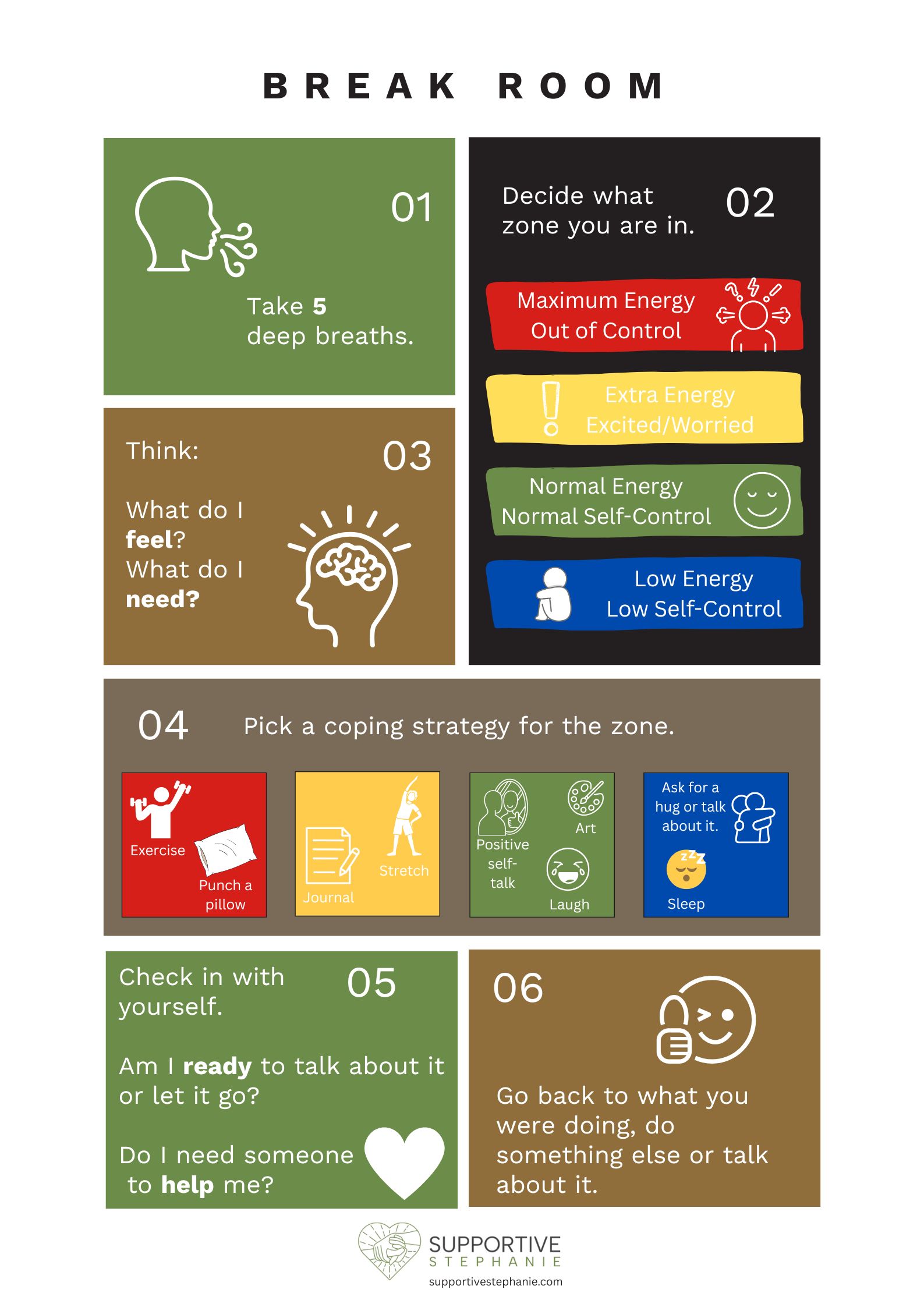
This poster is designed to help humans of all ages work through the big feelings that come with a flipped lid of any kind. It uses simple pictures and minimal words to guide us through the steps that take us from being overwhelmed to being ready to solve a problem. These steps are arranged in the order that has worked best for me, both at home and in my classroom. To use this free resource, simply print it and place it in the designated break space. Then, you will practice the steps together until the kid(s) are familiar with them and feel ready to do them alone.
Step 1: Take Five Deep Breaths.
This is the fastest way to get your thinking brain back online, an essential step for effective problem-solving. I highly recommend square breathing!
Step 2: Identify the Zone
I have kids identify their zone first because it can be a better indicator of what coping strategy they will need than their emotions. When I have them think about the zone first, it helps them choose the most helpful solution.
Step 3: Identify Emotions and Needs
Once they have identified their zone, they are more likely to accurately identify their feelings and needs, an essential step in solving a problem.
Step 4: Coping Strategy
Next, it is time to deal with the big feelings. We do this by choosing a coping strategy that matches our zone and needs. Each zone has a few suggested strategies that are both effective and largely independent.
Step 5: Check In with Yourself
This is an essential step. It is normal to need to use more than one coping strategy before you are fully back to your best self. It is crucial to understand what it feels like when you are truly calm and ready to solve a problem.
Step 6: Resolution
If the problem requires resolution or problem-solving, this is where it would happen. Sometimes, all we need is a break, and we are ready to get back to work. Sometimes, we need to solve a bigger problem.
How To Get It
Click this link and let me know how you found me. You will then be taken to the free resource page. My suggestion is to bookmark it so you don’t have to fill out the form each time.
##childdevelopment ##classroommanagement ##emotionalintelligence ##raisinghumans ##SEL ##self-regulation
Categories: